Your Thin film interference equation images are available. Thin film interference equation are a topic that is being searched for and liked by netizens now. You can Find and Download the Thin film interference equation files here. Find and Download all royalty-free photos.
If you’re searching for thin film interference equation pictures information related to the thin film interference equation keyword, you have pay a visit to the right blog. Our website always gives you hints for downloading the maximum quality video and image content, please kindly hunt and find more informative video content and images that match your interests.
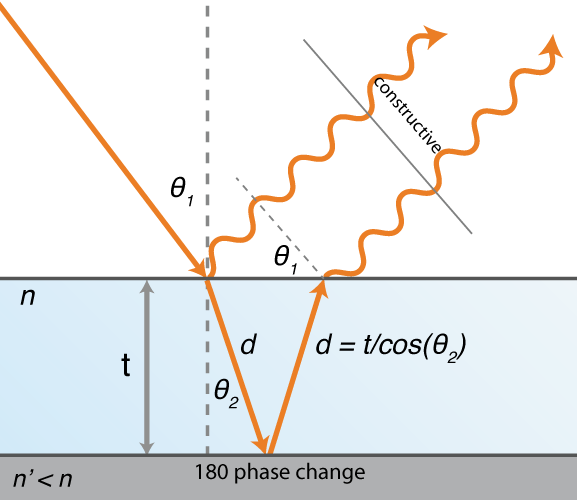
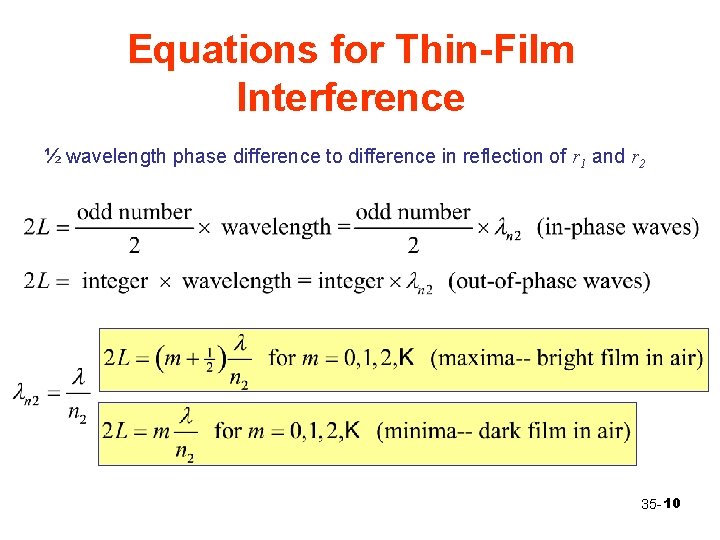
Thin Film Interference Equation. Interference maxima and minima. When the film is excessively thin such that its thickness t. If the angle of incidence on the film is α the index of refraction of the film is n the thickness of the film is d micrometers and the order of wavelengths m then the angle in the film is β from Snells law The wavelength for maximum reflection is λr nm. OPD mλ where m is an integer then destructive interference can occur.
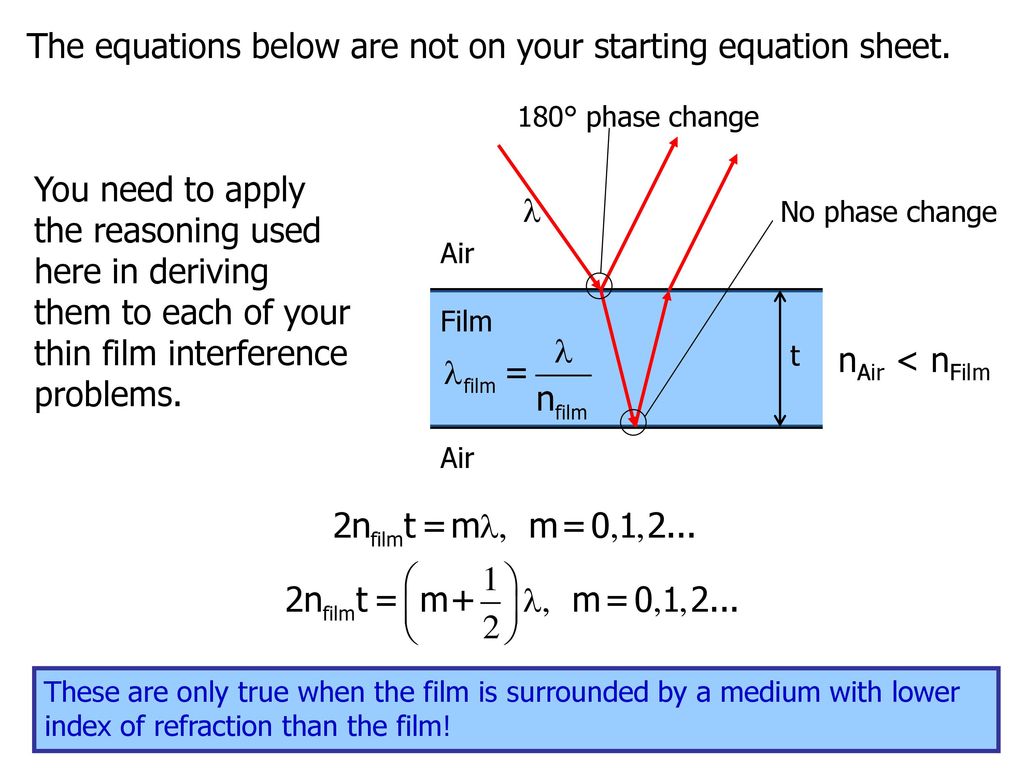 Today S Agenda Thin Film Interference Ppt Download From slideplayer.com
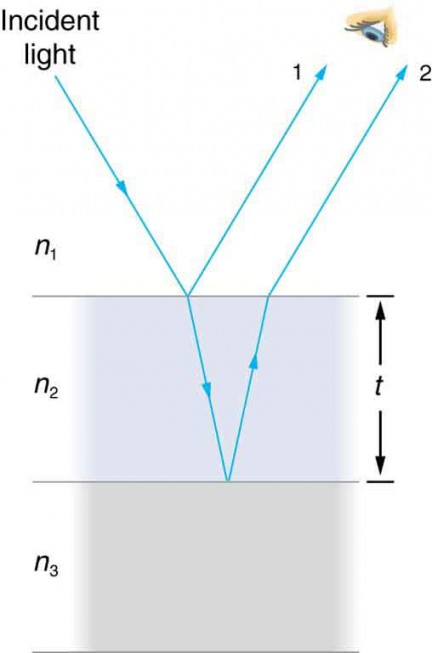
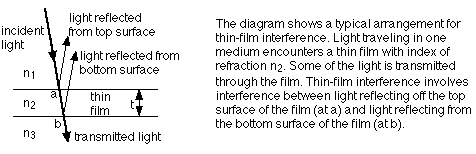
Equations to relate the thickness of the film angle of refraction and wavelength of light that experiences either constructive or destructive interference. Hat n_x costheta_x u_x iv_x where beginalign 2u_x2 a_x sqrt a_x2 4 b_x2 2v_x2 -a_x sqrt a_x2 4 b_x2 endalign and beginalign. The effective path difference between the interfering waves in reflected light for a film is 2ut cosr - 2. OPD mλ where m is an integer then destructive interference can occur. Thin Film Interference 12 n1 n2 n3 n1. When the path difference is an integer 12 number of wavelengths.
Minima 2 2t m 1 n air.
Hat n_x costheta_x u_x iv_x where beginalign 2u_x2 a_x sqrt a_x2 4 b_x2 2v_x2 -a_x sqrt a_x2 4 b_x2 endalign and beginalign. If the path difference is 12 wavelength then that adds a 180 degree phase shift which added to the original 180 degree phase difference puts them in phase. For a thick film thickness a t 14 Þ  ncoat we obtain a net change of ½ wavelength. Minima 2 2t m 1 n air. Well the quality of a medium that determines whether light travels quickly or slowly is called the index of refraction which is very important in this formula. λ n.
 Source: youtube.com
OPD mλ where m is an integer then destructive interference can occur. The two reflected waves interfere constructively Minimum. When the path difference is an integer 12 number of wavelengths. Standard analysis of Thin Film Interference 1 1 1 2 2 Max constructive 2 Min destructive n n dm dm λ λ d n 1 n 2 Angle shown but actually n normally incident 0 1 1 1 n n λ λ Wavelength inside film. In this situation we are asked to find the minimum thickness of the film.
 Source: sciencecalculators.org
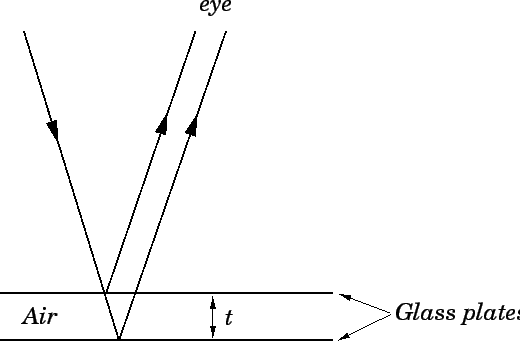
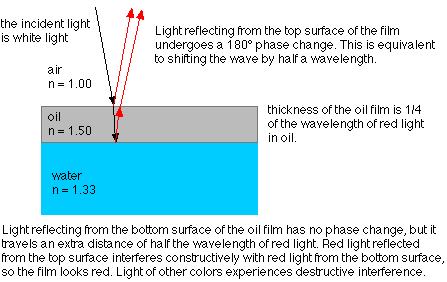
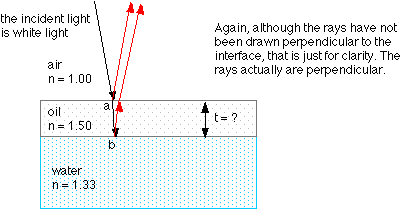
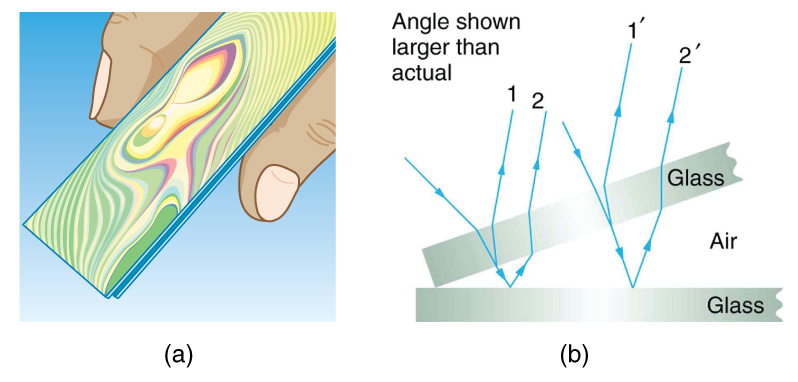
Equations to relate the thickness of the film angle of refraction and wavelength of light that experiences either constructive or destructive interference. OPD mλ where m is an integer then destructive interference can occur. D Interference due to an infinitely thin film When the thin of the film is small compared to the wave length of light t. Thin film interference occurs when light reflects multiple times off the two sides of a thin transparent material. This phase change is important in the interferencewhich occurs in thin films the design of anti-reflection coatings interference filters and thin film mirrors.
 Source: physicsforums.com
Thicknesses on the order of 01 μm10 μm ¼λ10λ of visible light within the film are considered thin. OPD mλ where m is an integer then destructive interference can occur. Thin film interference Thin. The light reflected from any one. The effective path difference between the interfering waves in reflected light for a film is 2ut cosr - 2.
 Source: slidetodoc.com
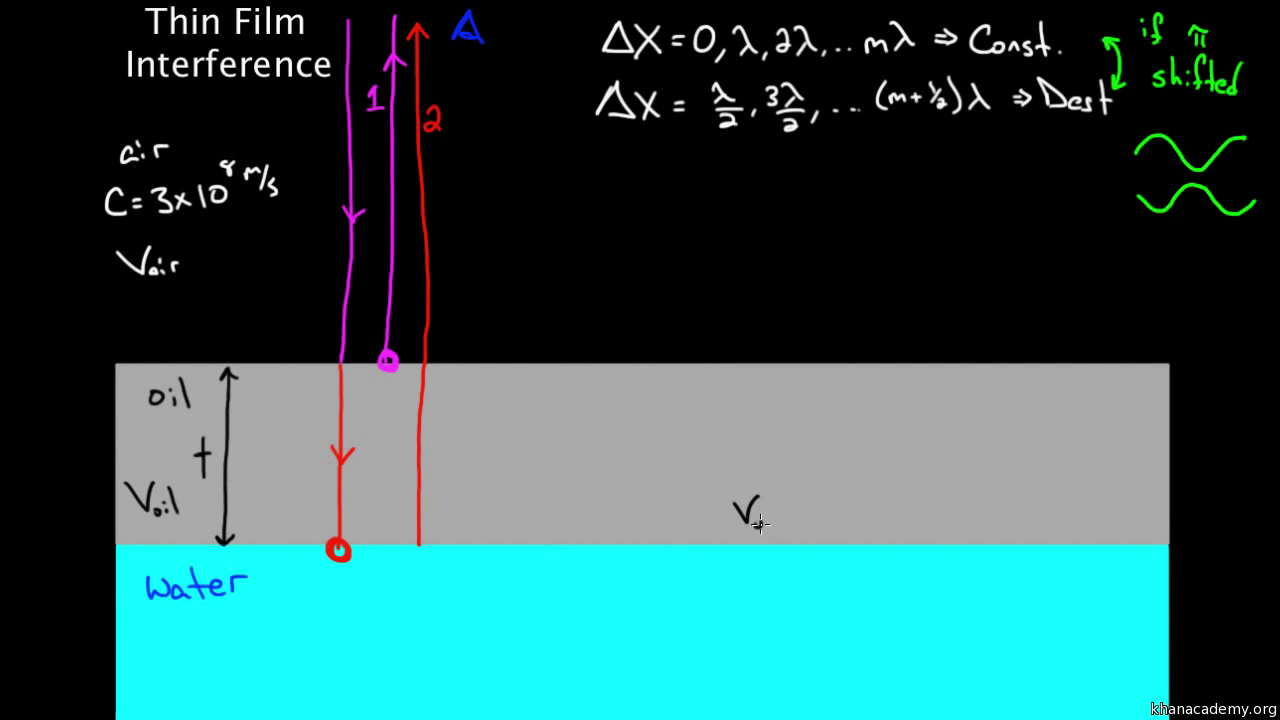
V cn where v is the speed of light in the medium c is the speed of light in a vacuum 3x10⁸ ms and n is the index of refraction. OPD mλ where m is an integer then destructive interference can occur. D Interference due to an infinitely thin film When the thin of the film is small compared to the wave length of light t. This means choosing the minimum value of m which in this case is m 0. Well the quality of a medium that determines whether light travels quickly or slowly is called the index of refraction which is very important in this formula.
 Source: farside.ph.utexas.edu
The equation can now be solved. And thats the key to thin films. Using their derivation of the Fresnel and interference equations for that specific situation as a guide for my purposes the following was found. Thin Film Interference 12 n1 n2 n3 n1. The basic conditions for interferencedepend upon whether the reflections involve 180 degree phase changes.
 Source: khanacademy.org
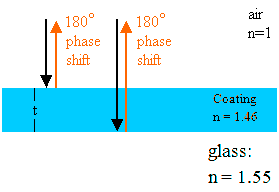
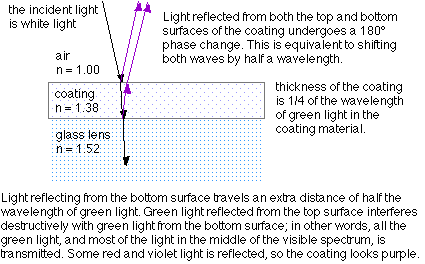
2 n t cos. Phase shift of the two reflected waves is 180oã for such a glass coating with normal incidence we must for constructive interference 2 NCOAT T MI  m 012 and by destructive interference we need 2 ncaat t m ½ i  m 12. Thin Film Interference 12 n1 n2 n3 n1. For a thick film thickness a t 14 Þ  ncoat we obtain a net change of ½ wavelength. When light hits a material that has multiple layers each layer can reflect light.
 Source: physics.bu.edu
Standard analysis of Thin Film Interference 1 1 1 2 2 Max constructive 2 Min destructive n n dm dm λ λ d n 1 n 2 Angle shown but actually n normally incident 0 1 1 1 n n λ λ Wavelength inside film. The basic conditions for interferencedepend upon whether the reflections involve 180 degree phase changes. Minima 2 2t m 1 n air. If the path difference is 12 wavelength then that adds a 180 degree phase shift which added to the original 180 degree phase difference puts them in phase. V cn where v is the speed of light in the medium c is the speed of light in a vacuum 3x10⁸ ms and n is the index of refraction.
 Source: labman.phys.utk.edu
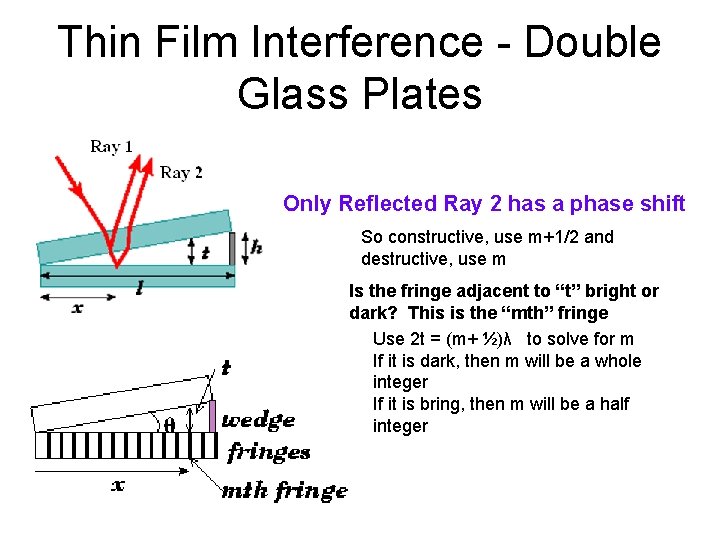
Phase shift of the two reflected waves is 180oã for such a glass coating with normal incidence we must for constructive interference 2 NCOAT T MI  m 012 and by destructive interference we need 2 ncaat t m ½ i  m 12. A couple of wavelengths of light Condition for maximum bright fringe. Phase shift of the two reflected waves is 180oã for such a glass coating with normal incidence we must for constructive interference 2 NCOAT T MI  m 012 and by destructive interference we need 2 ncaat t m ½ i  m 12. The optical properties of thin films arise from interferenceand reflection. Using their derivation of the Fresnel and interference equations for that specific situation as a guide for my purposes the following was found.
 Source: physics.stackexchange.com
This means choosing the minimum value of m which in this case is m 0. Thicknesses on the order of 01 μm10 μm ¼λ10λ of visible light within the film are considered thin. λ n. Hat n_x costheta_x u_x iv_x where beginalign 2u_x2 a_x sqrt a_x2 4 b_x2 2v_x2 -a_x sqrt a_x2 4 b_x2 endalign and beginalign. This is not the only thickness that gives completely constructive interference for this wavelength.
 Source: courses.lumenlearning.com
Well the quality of a medium that determines whether light travels quickly or slowly is called the index of refraction which is very important in this formula. Equations to relate the thickness of the film angle of refraction and wavelength of light that experiences either constructive or destructive interference. 2 n t cos. Thicknesses on the order of 01 μm10 μm ¼λ10λ of visible light within the film are considered thin. The two reflected waves interfere constructively Minimum.
 Source: physics.bu.edu
The effective path difference between the interfering waves in reflected light for a film is 2ut cosr - 2. Equations to relate the thickness of the film angle of refraction and wavelength of light that experiences either constructive or destructive interference. So where do I have constructive interference. The basic conditions for interferencedepend upon whether the reflections involve 180 degree phase changes. Light on thin films.
 Source: slidetodoc.com
Minima 2 2t m 1 n air. Interference maxima and minima. When light hits a material that has multiple layers each layer can reflect light. Using their derivation of the Fresnel and interference equations for that specific situation as a guide for my purposes the following was found. The optical properties of thin films arise from interferenceand reflection.
Source: slideplayer.com
Phase shift of the two reflected waves is 180oã for such a glass coating with normal incidence we must for constructive interference 2 NCOAT T MI  m 012 and by destructive interference we need 2 ncaat t m ½ i  m 12. Standard analysis of Thin Film Interference 1 1 1 2 2 Max constructive 2 Min destructive n n dm dm λ λ d n 1 n 2 Angle shown but actually n normally incident 0 1 1 1 n n λ λ Wavelength inside film. Using their derivation of the Fresnel and interference equations for that specific situation as a guide for my purposes the following was found. This phase change is important in the interferencewhich occurs in thin films the design of anti-reflection coatings interference filters and thin film mirrors. This means choosing the minimum value of m which in this case is m 0.
 Source: physics.bu.edu
The optical properties of thin films arise from interferenceand reflection. This is not the only thickness that gives completely constructive interference for this wavelength. When the film is excessively thin such that its thickness t. When light hits a material that has multiple layers each layer can reflect light. When the path difference is an integer 12 number of wavelengths.
 Source: courses.lumenlearning.com
And thats the key to thin films. Using their derivation of the Fresnel and interference equations for that specific situation as a guide for my purposes the following was found. OPD mλ where m is an integer then destructive interference can occur. Phase shift of the two reflected waves is 180oã for such a glass coating with normal incidence we must for constructive interference 2 NCOAT T MI  m 012 and by destructive interference we need 2 ncaat t m ½ i  m 12. A couple of wavelengths of light Condition for maximum bright fringe.
 Source: youtube.com
D Interference due to an infinitely thin film When the thin of the film is small compared to the wave length of light t. Standard analysis of Thin Film Interference 1 1 1 2 2 Max constructive 2 Min destructive n n dm dm λ λ d n 1 n 2 Angle shown but actually n normally incident 0 1 1 1 n n λ λ Wavelength inside film. Thin film interference occurs when light reflects multiple times off the two sides of a thin transparent material. If the angle of incidence on the film is α the index of refraction of the film is n the thickness of the film is d micrometers and the order of wavelengths m then the angle in the film is β from Snells law The wavelength for maximum reflection is λr nm. Minima 2 2t m 1 n air.
 Source: youtube.com
D Interference due to an infinitely thin film When the thin of the film is small compared to the wave length of light t. Air soap air bright fringes 2t m Maxima. If the path difference is 12 wavelength then that adds a 180 degree phase shift which added to the original 180 degree phase difference puts them in phase. V cn where v is the speed of light in the medium c is the speed of light in a vacuum 3x10⁸ ms and n is the index of refraction. Thin Film Interference 12 n1 n2 n3 n1.
 Source: physics.bu.edu
Phase shift of the two reflected waves is 180oã for such a glass coating with normal incidence we must for constructive interference 2 NCOAT T MI  m 012 and by destructive interference we need 2 ncaat t m ½ i  m 12. Standard analysis of Thin Film Interference 1 1 1 2 2 Max constructive 2 Min destructive n n dm dm λ λ d n 1 n 2 Angle shown but actually n normally incident 0 1 1 1 n n λ λ Wavelength inside film. Interference maxima and minima. λ n. Well the quality of a medium that determines whether light travels quickly or slowly is called the index of refraction which is very important in this formula.
This site is an open community for users to do sharing their favorite wallpapers on the internet, all images or pictures in this website are for personal wallpaper use only, it is stricly prohibited to use this wallpaper for commercial purposes, if you are the author and find this image is shared without your permission, please kindly raise a DMCA report to Us.
If you find this site helpful, please support us by sharing this posts to your own social media accounts like Facebook, Instagram and so on or you can also save this blog page with the title thin film interference equation by using Ctrl + D for devices a laptop with a Windows operating system or Command + D for laptops with an Apple operating system. If you use a smartphone, you can also use the drawer menu of the browser you are using. Whether it’s a Windows, Mac, iOS or Android operating system, you will still be able to bookmark this website.